
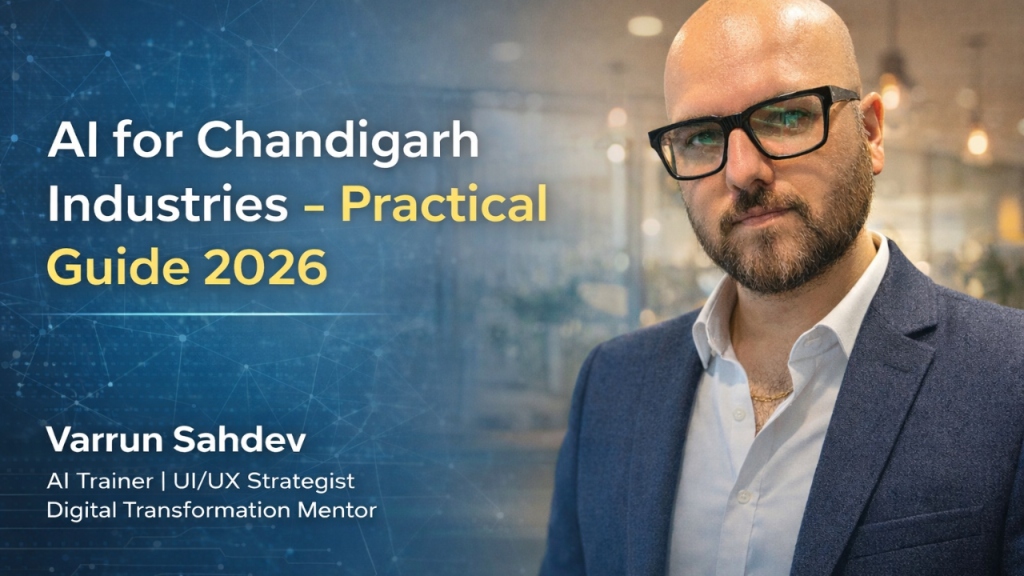
Chandigarh has always stood as a symbol of smart and intelligent design.
India’s first planned city, widely recognized for its architectural precision, infrastructure clarity, and high quality of life, and today, proudly positioned as a Smart City — Chandigarh represents structured thinking at scale.
As India’s first planned city and a growing Smart City, Chandigarh now has the opportunity to lead a new phase of industrial transformation, one powered by artificial intelligence.
In 2026, AI is no longer a futuristic concept reserved for large enterprises. It is becoming a practical business tool for manufacturers, logistics firms, real estate companies, educational institutions, and service businesses across Chandigarh and the wider Tricity region.
For local industries, the real question is no longer whether AI should be adopted.
National tailwinds amplify this: India’s manufacturing GVA grew strongly in FY 2025-26, with policies like the National Manufacturing Mission, PLI schemes, and a ₹10,000 crore SME Growth Fund pushing for deeper global integration. Chandigarh’s economy, already strong in services via the Rajiv Gandhi Technology Park and growing IT/ITES presence, now faces a clear imperative: AI is no longer a futuristic luxury, it’s a competitive necessity. Businesses that delay adoption risk falling behind in efficiency, innovation, and market relevance, especially as India’s AI market surges and enterprises increasingly integrate GenAI tools (with over 90% of employees using them in some surveys).
“Many leaders in Chandigarh view AI as ‘just chatbots’ or ‘expensive software that replaces jobs.’ This underestimates its true power. AI today is augmenting intelligence—not replacing human insight—through predictive analytics, optimization, and decision support.”
Strategic Regional Perspective
- It’s not only for tech giants: Affordable, open-source tools and India-specific SLMs (Small Language Models) make it accessible for SMEs.
- It’s not job-killing: It shifts roles toward higher-value work (e.g., oversight, strategy) while creating demand for AI-skilled talent.
- It’s not plug-and-play without strategy: Success requires alignment with business goals, training, and cultural buy-in.
In Chandigarh’s context—where many units are family-run SMEs in auto parts, pharmaceuticals, or light engineering—AI means turning constraints (like supply chain volatility or manual processes) into advantages.
Practical, India-Relevant Use Cases for Chandigarh’s Key Sectors
Here are grounded examples tailored to our regional industries:
Manufacturing (Auto Components, Tractor Parts, Pharmaceuticals, Light Engineering)
AI enables predictive maintenance to cut downtime by 30-40%, quality inspection via computer vision for defect detection (reducing waste), and demand forecasting to optimize production runs. Local example potential: A Chandigarh-based auto parts SME could use AI to predict machine failures from sensor data, minimizing disruptions in supply to Punjab/Haryana OEMs. National trends show 73% of Indian manufacturers planning AI adoption, with gains in efficiency up to 25%.
Logistics & Supply Chain
With Chandigarh’s strategic location aiding regional trade, AI optimizes route planning, inventory management, and demand prediction—reducing costs in express logistics (a growing segment post-GST and FASTag). An SME transporter could deploy AI for real-time forecasting, avoiding overstocking during festive seasons, freeing cash for growth.
Real Estate
AI adoption in Indian CRE has exploded (from <5% in 2023 to 91% in 2025), powering property valuation, tenant matching, predictive maintenance for commercial spaces, and virtual tours. Chandigarh developers could use AI for market trend analysis in high-impact areas (e.g., Industrial Phase 3 or Mohali extensions), optimizing pricing and reducing vacancy in hospitality or office projects.
Education & Training Institutions
Chandigarh’s strong academic ecosystem (universities, skill centers) can leverage AI for personalized learning, administrative automation, and upskilling programs. Institutions could run AI-driven platforms to prepare students for industry needs, aligning with national skilling drives.
Marketing Agencies & SMEs
AI tools analyze customer data for targeted campaigns, content generation, and sentiment tracking—boosting ROI for local agencies serving regional brands. SMEs in food processing or sanitary fittings could use AI for personalized outreach, increasing sales conversions.
These aren’t theoretical; they draw from proven Indian deployments (e.g., in manufacturing for predictive analytics or logistics for route optimization) and are scalable with low-entry tools.
A Simple Step-by-Step AI Adoption Framework for Chandigarh Businesses
To move from curiosity to impact, follow this phased, practical approach:
- Awareness & Assessment: Audit current processes, identify pain points (e.g., manual inventory, quality checks), and build basic AI literacy across leadership. Start with free resources or short sessions.
- Training & Skill Building: Invest in hands-on upskilling—focus on practical tools (no-code/low-code platforms, GenAI for workflows). This is where targeted workshops shine: empowering teams to experiment safely.
- Pilot Projects: Select 1-2 high-impact, low-risk use cases (e.g., AI for demand forecasting in manufacturing). Use affordable tools; measure ROI quickly (e.g., 20-30% efficiency gains).
- Workflow Integration & Scaling: Embed AI into daily operations (e.g., dashboards for predictive insights). Integrate with existing ERP/CRM; monitor and iterate.
- Cultural Alignment & Sustainability: Foster a human-AI collaboration mindset—celebrate wins, address fears, and tie to business goals. Build internal champions and plan for continuous learning.
This framework minimizes risk while delivering quick wins, especially vital for resource-constrained SMEs.
Why Strategic Guidance Matters
Many businesses try adopting AI through random tools. That approach leads to:
- Wasted subscriptions
- Unused dashboards
- Confused teams
- Frustration
Effective AI transformation requires bridging:
- Business strategy
- User experience design
- Workflow optimization
- Team capability building
As a Senior Lead UI/UX Designer and AI Trainer with 19 years of experience, I work with organizations to:
- Simplify AI for non-technical teams
- Design human-centered AI workflows
- Conduct hands-on workshops
- Identify practical pilot projects
- Align leadership with execution
AI is not just a toolset. It is a design problem, a cultural problem, and a systems problem.
And when implemented strategically, it becomes a competitive multiplier.
The Opportunity for Chandigarh in 2026
Cities like Chandigarh have a unique advantage. They are agile enough to adapt. Large enough to scale. Small enough to align quickly.
The businesses that act now will define the regional competitive landscape for the next decade. The ones that wait may find themselves reacting instead of leading.
For Chandigarh industries, 2026 is the right time to move from curiosity to capability.
If you are a business owner, founder, HR leader, or operations manager in Chandigarh and want to explore practical AI adoption through workshops, consulting, or transformation sessions, I’d be glad to connect.
Let’s move from curiosity to capability. From experimentation to integration. From awareness to advantage.
Reach out via LinkedIn (linkedin.com/in/varrunsahdev) or message me directly to discuss your needs. Together, we can position Chandigarh’s industries at the forefront of India’s AI-driven growth in 2026 and beyond.