
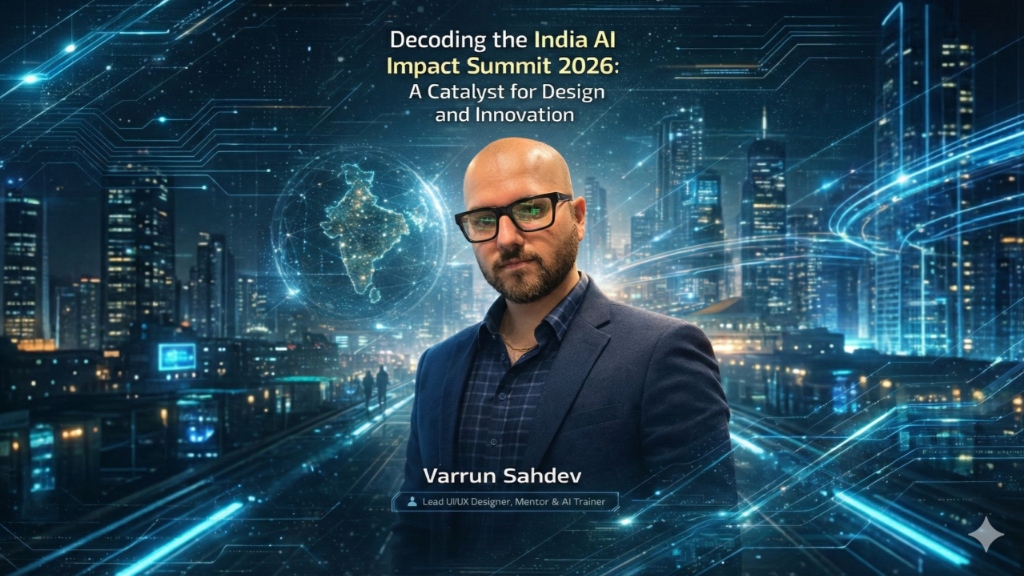
The India AI Impact Summit 2026, held in New Delhi from February 19-20 with pre-events starting February 15, marked a pivotal moment in global AI discourse. As the first major AI summit hosted in the Global South, it brought together over 35,000 participants from 100+ countries, including world leaders, tech CEOs, researchers, and startups.
This event wasn't just about showcasing technology; it emphasized practical, inclusive applications that could reshape industries like design, where AI is increasingly integral to creative processes. For young designers, UI/UX professionals, product thinkers, and AI enthusiasts, the summit offered a roadmap to navigate this evolving landscape. Let's break down the key outcomes and their implications.
1. Summit Overview
Purpose and Scale
The summit, inaugurated by Prime Minister Narendra Modi, aimed to transition from AI discussions to demonstrable impact, aligning with India's vision of "AI for ALL." Hosted under the IndiaAI Mission by the Ministry of Electronics and Information Technology (MeitY), it focused on democratizing AI resources, fostering inclusive development, and ensuring ethical governance. The scale was immense: 500+ sessions, 600+ startups, 300+ exhibitors across 10 thematic pavilions, and an expo featuring innovations in healthcare, agriculture, education, and more. PM Modi highlighted AI's role in empowering society, from rural empowerment programs to global collaborations, setting a tone of actionable progress rather than abstract theory.
Key Themes and Focus Areas
Core themes revolved around Generative AI, Responsible AI, AI infrastructure, skilling, and startups. Sessions explored human-centric AI, multilingual models for India's diverse languages, and sustainable applications for the planet. For instance, the "AI for ALL: Global Impact Challenge" invited proposals for scalable solutions in urban mobility, climate sustainability, and financial inclusion, emphasizing AI's potential to address real-world challenges. Responsible AI was a recurring motif, with discussions on bias detection, deepfake tools, and "techno-legal" frameworks to ensure transparency and accountability. Infrastructure and skilling were spotlighted, with plans to train 10 million Indians in AI, positioning the country as a talent hub.
2. Major Announcements & Outcomes
Government Initiatives and Policy Frameworks
The government unveiled a full-stack AI strategy, covering applications, models, chips, infrastructure, and energy for a "frugal, sovereign, and scalable" ecosystem. Key policies included a "DPI approach" to AI, treating it as public infrastructure to broaden access beyond big firms. Minister Ashwini Vaishnaw outlined AI Mission 2.0, focusing on safety-aligned outcomes and workforce reform. A notable push was for sovereign AI models within a year, rejecting dependency on foreign tech.
Funding Programs, AI Missions, or National Infrastructure
Funding stole the spotlight: A $1.1 billion state-backed VC fund for AI startups and advanced manufacturing. Overall, $200 billion in infrastructure commitments and $17 billion in VC funding were pledged, including 20,000+ GPUs added to India's 38,000-base. Subsidized compute access at one-third global rates via a national GPU pool was announced for students, startups, and researchers. Adani Group committed $100 billion for renewable-powered data centers by 2035, leveraging India's 51% clean energy generation.
Industry Partnerships and Global Collaborations
Global tie-ups were abundant: Google announced a $15 billion AI hub in Visakhapatnam; AMD partnered with TCS for AI infrastructure; Infosys with Anthropic for enterprise solutions; and Anthropic opened its first India office. UK-India partnerships advanced open AI ecosystems, while France collaborated on responsible governance. These signal India's shift from consumer to co-creator in AI.
Launches of AI Platforms, Datasets, or Innovation Hubs
Standouts included BharatGen's Param2 (17B-parameter model supporting 22 Indian languages) and Sarvam AI's vernacular-focused tools like Sarvam Kaze smartglasses for on-device multilingual interaction. Gnani's Inya VoiceOS and Cohere's TinyAya for offline, multilingual use were demoed, alongside humanoid robots and AI for special needs. Innovation hubs like Yotta's GPU expansion with Nvidia underscore scalable deployment.
3. Impact on the Design Ecosystem
AI's integration into design workflows was implicitly highlighted through generative tools and human-AI collaboration demos. For UI/UX professionals, tools like Sarvam Vision reshape ideation by enabling vernacular prototyping, allowing designers to create interfaces for non-English users seamlessly.
How AI is Reshaping UI/UX Workflows
Generative AI automates repetitive tasks, such as wireframing or A/B testing variations, freeing designers for high-level strategy. Real-world scenarios: A UX team could use BharatGen to generate culturally attuned icons for a multilingual app, reducing iteration time from weeks to hours.
Human-AI Collaboration in Product Design
The summit emphasized augmentation over replacement. Product thinkers can collaborate with AI copilots for user research, analyzing vast datasets to uncover insights. For instance, AI-driven sign language translation gloves showcased how multimodal AI enhances inclusive design.
Automation vs Augmentation in Creative Fields
While automation handles layout optimization, augmentation shines in ethical creativity—bias detection tools ensure fair representations. Speakers like Vinod Khosla warned of disappearing routine jobs, urging designers to focus on AI-orchestrated innovation.
Rise of AI-Native Design Tools and Interfaces
Launches like TinyAya enable on-device AI for portable design tools, fostering "AI-native" interfaces that adapt in real-time. This democratizes access, allowing young designers in remote areas to build portfolios with global standards.
4. Opportunities for Young Designers
The summit revealed AI as a career accelerator, not a threat, for emerging talent.
New Career Pathways Emerging from AI
Roles like AI prompt engineers or ethical design specialists are booming. With 10 million skilling targets, pathways include AI-integrated product management, where designers lead human-centric AI projects.
Skills Designers Must Learn
Master prompting for generative tools, multimodal design (voice/image integration), AI ethics, and basic research. Practical takeaway: Experiment with tools like Claude or BharatGen to simulate user flows ethically.
Portfolio Evolution in the AI Era
Portfolios now showcase AI collaborations—e.g., a UI project augmented by Sarvam Kaze. Highlight process: How AI sped ideation while human oversight ensured originality.
Working Alongside AI Agents and Copilots
Envision daily workflows with AI agents handling data visualization, allowing focus on empathy-driven design. Summit demos showed this in action, like AI for precision farming interfaces, adaptable to user needs.
5. Lessons for AI Enthusiasts & Builders
For builders, the event was a call to action on grounded innovation.
Innovation Gaps to Explore
Gaps in vernacular AI and sustainable compute offer niches—e.g., building AI for India's 22 languages or edge-device tools for low-bandwidth areas.
Startup and Product Opportunities
With $1.1 billion funding, startups can target AI-native products like smartglasses. Opportunities in agentic commerce or rural AI applications abound.
Responsible AI and Governance Takeaways
Key lesson: Integrate "techno-legal" safeguards early. Governance frameworks stress transparency, with tools for unlearning biases.
India’s Positioning in the Global AI Race
Ranked third in AI readiness by Stanford, India positions as the "largest AI services hub," leveraging talent and clean energy for sovereign, inclusive AI.
6. Future Outlook
What the Next 3–5 Years May Look Like
Expect widespread AI adoption in design: Tools evolving from assistants to co-creators, with sovereign models enabling localized innovation. Infrastructure growth could see India exporting AI solutions to the Global South.
Role of India in Democratizing AI
As a bridge-builder, India will democratize access via subsidized compute and open platforms, ensuring AI benefits accrue equitably.
Predictions for AI-Driven Design and Digital Experiences
In 3-5 years, AI-native interfaces will dominate, with multimodal designs creating immersive, personalized experiences. For young professionals, this means thriving by blending creativity with AI literacy—turning summit outcomes into career catalysts.
The India AI Impact Summit 2026 wasn't hype; it provided tangible directions for your next project or skill upgrade. By focusing on responsible, inclusive AI, it equips you to shape a future where design and technology amplify human potential.
As AI continues to redefine how we design, build, and innovate, staying ahead of this shift is no longer optional—it’s strategic. The insights from the India AI Impact Summit 2026 reinforce one clear direction: designers who integrate AI into their thinking, workflows, and products will lead the next era of digital experiences.
About the Author
Varrun Sahdev — Lead UI/UX Designer, Mentor & AI TrainerWith 18+ years of experience spanning UI/UX strategy, product design, branding, and AI-assisted innovation, Varrun works at the intersection of design, technology, and human behavior. His work focuses on helping organizations, startups, and professionals adopt AI meaningfully within design ecosystems—bridging creativity with computational intelligence.
Services & Engagement Offerings
- AI for Designers – Corporate & Academic Workshops
- UI/UX Strategy & Product Consulting
- AI-Integrated Design Workflow Training
- Portfolio & Career Mentorship for Designers
- Enterprise Design Thinking Programs
- Human-AI Collaboration Frameworks
Contact & Collaboration
For workshops, consulting, speaking engagements, or training programs: